


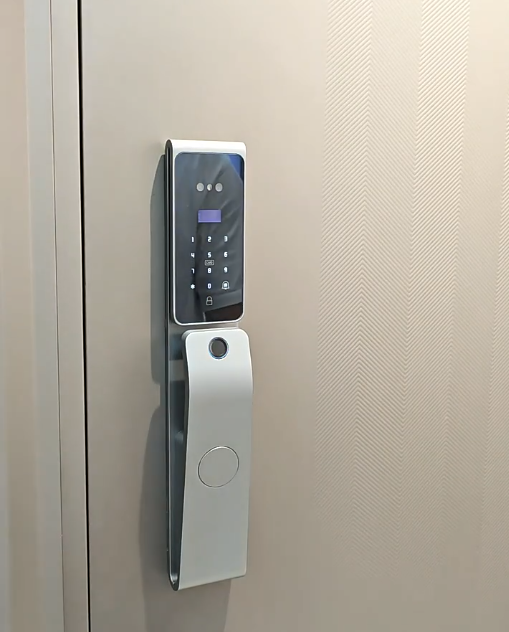
The smart door lock deadbolt is the part that actually holds your door shut against force — the solid metal bolt that extends into the door frame. All the fingerprints and apps in the world mean nothing if the deadbolt is weak, so understanding it is key to choosing a secure lock. This guide explains how a smart door lock deadbolt works, the difference between single and multi-bolt designs, and why motor-driven bolts are stronger than handle-operated ones. Browse complete units on our smart door lock range as you read.
When you strip a lock back to what keeps intruders out, it comes down to the deadbolt — so it deserves real attention.

What is a deadbolt?
A deadbolt is a solid metal bolt that slides from the lock body into the door frame to hold the door shut. Unlike a spring latch, it can’t be pushed back by force or slipped with a card — it stays “dead” in place until deliberately withdrawn. This is why the deadbolt is the core security element of any serious lock, including a smart one. The stronger and deeper the bolt, the harder the door is to force.
How a smart lock operates the deadbolt
In a smart door lock, the deadbolt is driven by a motor. When you present a valid fingerprint, face, code or card, the controller signals the motor to withdraw the bolt and the door opens; it extends the bolt again to lock. This motorised operation is what enables features like auto-lock, where the door secures itself after a set time. The motor’s strength and durability directly affect how reliably and how long the deadbolt works.
Single-bolt vs multi-bolt locks
Basic locks use a single deadbolt, which is adequate but gives just one point of resistance. Stronger locks use a multi-bolt design — typically four or five bolts engaging the frame at several points — which spreads force and dramatically increases resistance to forcing or prying. For a main door, a multi-bolt body is a meaningful security upgrade. Covlor locks use multi-bolt bodies for exactly this reason, engaging the frame at multiple points.
Single-bolt vs multi-bolt vs motor-driven: a comparison
This table summarises how different deadbolt designs compare on the things that matter most for security and everyday use.
| Design | Points of resistance | Auto-lock possible? | Relative strength |
|---|---|---|---|
| Single spring latch | None (not a true deadbolt) | No | Low — can be slipped |
| Single deadbolt | One | Only if motor-driven | Moderate |
| Multi-bolt, handle-operated | Several | No — needs a handle turn | Good, but linkage can wear |
| Multi-bolt, motor-driven (Covlor) | Several (4–5 bolts) | Yes | Strong and fully automatic |
Why motor-driven bolts beat handle-operated ones
Some cheaper smart locks still require you to turn a handle to throw the bolts, with electronics only releasing a latch. These handle-rotation designs are often weaker and rely on a mechanical linkage that wears. Covlor takes a different approach: Covlor locks drive every bolt in and out with an all-metal gear motor rather than a rotating handle, which lasts roughly twice as long as plastic-geared motors. Every bolt is extended and withdrawn by the motor, giving a stronger, fully automatic action with no reliance on a handle turn. Our guide on locks without a rotating handle explains why this matters.
The importance of a durable motor
Because the motor drives the deadbolt on every cycle, its durability is critical. A plastic-geared motor wears and can strip over thousands of operations — a common failure point in budget locks. Covlor’s all-metal gear motor lasts roughly twice as long, handling the daily cycling of the deadbolt without wearing out. A strong deadbolt is only as good as the motor that drives it, so build quality here is essential.
Auto-lock and the deadbolt
One of the best features a motorised deadbolt enables is auto-lock: the bolt extends automatically after the door closes or after a set delay, so you never accidentally leave the door unlocked. For busy households, this quietly closes a common security gap. It’s only possible because the deadbolt is motor-driven — a handle-operated bolt can’t lock itself. This is another practical advantage of a fully motorised smart door lock deadbolt.
Deadbolt security features
Beyond the bolt itself, look for anti-tamper hardware that resists prying, hardened materials that resist drilling and cutting, and a tamper alarm on connected models that sounds if someone attacks the lock. These features protect the deadbolt and the door around it. Combined with a multi-bolt body and durable motor, they make the lock genuinely hard to force — which is, ultimately, the whole point.
What to check when buying
When assessing a smart door lock deadbolt, confirm: is it a multi-bolt body engaging the frame at several points? Are the bolts driven by a durable metal-gear motor rather than a handle turn? Does it offer auto-lock? And is the hardware anti-tamper? Covlor’s lineup — the CR-L108, CR-L99, CR-L88 and CR-L51 — offers face and palm recognition, fingerprint, PIN, card and app control, multi-bolt bodies driven by an all-metal gear motor, wide 40–120 mm door-thickness support and emergency USB-C power. Tick these and your door’s core security is solid. Compare models on our smart door lock shop or in our best smart door lock guide.
How the deadbolt fits your door and frame
A deadbolt is only as strong as what it extends into. Even the best multi-bolt lock needs a solid door and a well-fitted strike plate in a sturdy frame — otherwise an intruder attacks the frame, not the bolt. When fitting a smart lock, ensure the bolts align cleanly with deep, reinforced strike points, and that the door itself is solid rather than hollow. A 40–120 mm thickness range covers most doors, but the frame matters as much as the lock. Getting this right means the deadbolt’s strength is fully realised rather than undermined by a weak surround. It’s worth having a professional confirm the alignment so the motor drives each bolt home without strain.
Deadbolts and everyday reliability
Beyond security, the deadbolt shapes how the lock feels every day. A motor-driven multi-bolt that seats cleanly gives a reassuring, consistent action each time you lock and unlock, with no stiff handle to wrestle. If the bolt ever drags — usually because the door has dropped slightly on its hinges or swollen in humidity — the motor works harder and battery life suffers, so a quick realignment keeps everything smooth. With a durable all-metal gear motor and clean alignment, a quality deadbolt operates thousands of times without complaint, quietly doing the most important job in your home’s security.
The bottom line
The smart door lock deadbolt is what truly secures your door, so it deserves more attention than the biometrics that get the headlines. Prioritise a multi-bolt body that engages the frame at several points, bolts driven by a durable all-metal gear motor rather than a vulnerable handle turn, auto-lock for peace of mind, and anti-tamper hardware. Get the deadbolt right and the rest of the lock’s convenience sits on a genuinely strong foundation.
Frequently asked questions
What is a smart door lock deadbolt?
It’s the solid metal bolt that slides from the lock into the door frame to hold the door shut against force. In a smart lock, the deadbolt is driven by a motor that withdraws it when you present a valid fingerprint, code or card, and extends it to lock.
Is a multi-bolt lock better than a single deadbolt?
Generally yes. A multi-bolt design — typically four or five bolts engaging the frame at several points — spreads force and resists forcing or prying far better than a single bolt. For a main door it’s a meaningful security upgrade. Covlor locks use multi-bolt bodies.
Why are motor-driven bolts better than handle-operated ones?
Motor-driven bolts are extended and withdrawn automatically by the motor, giving a stronger action with no reliance on a handle turn that can wear or be weaker. They also enable auto-lock. Covlor drives every bolt with an all-metal gear motor rather than a rotating handle.
Does a smart lock deadbolt lock automatically?
If it’s motor-driven and offers auto-lock, yes — the bolt extends automatically after the door closes or after a set delay, so you never leave the door unlocked. A handle-operated bolt can’t lock itself, which is one advantage of a fully motorised smart lock.
Does the door frame affect deadbolt security?
Yes, significantly. A deadbolt is only as strong as what it extends into, so you need deep, reinforced strike points in a solid frame and a sturdy door. Even the best multi-bolt lock is undermined by a weak frame, so ensure clean alignment and a strong surround when fitting.
Explore the range: see current models, features and prices on the Covlor smart door locks shop, or message us on WhatsApp +91 8860055551 for help choosing the right lock for your door.

