


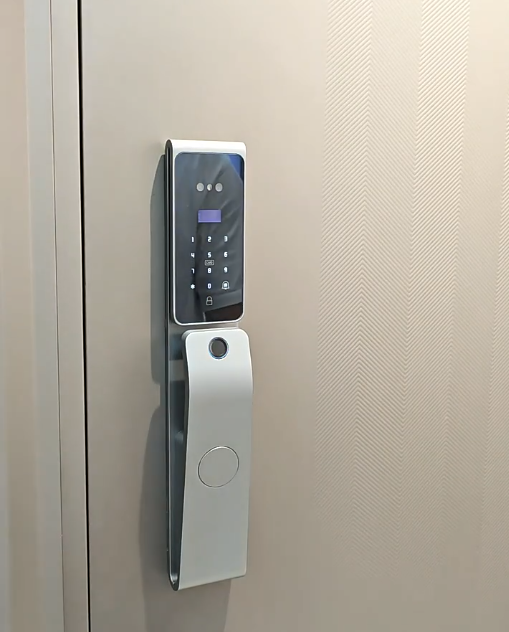
Choosing a smart door lock USA homes can rely on means weighing the universal fundamentals — biometrics, build, battery and security — alongside a few American specifics: deadbolt standards, common door types, and the smart-home ecosystem you use. The US market is large and varied, so knowing what to prioritise helps you choose well. This buyer’s guide covers what matters when selecting a smart lock in the USA, from security grading to connectivity. Browse the range on our smart door lock shop as you consider options.
With the right priorities, a smart lock fits American homes and lifestyles seamlessly.

Why smart locks suit US homes
American households have embraced smart-home technology, and smart locks are among the most popular upgrades. Keyless entry suits busy families, remote access fits frequent travellers, and the ability to issue codes is ideal for guests, cleaners, dog-walkers and deliveries. For the large US short-term-rental market, remote code management is invaluable. A smart lock is a natural fit for the connected American home.
Deadbolt standards and security grading
US locks are often rated by security grade, and a smart lock’s deadbolt is what truly secures the door. The table below outlines what to look for in terms of strength and design.
| Priority | What to look for | Why it matters |
|---|---|---|
| Deadbolt strength | Solid, deep-throw bolt | Resists forcing |
| Multi-bolt option | Several bolts engaging the frame | Spreads force, harder to pry |
| Drive type | Motor-driven, not handle-turned | Stronger, enables auto-lock |
| Tamper resistance | Anti-tamper, hardened hardware | Resists prying and drilling |
Door types in the USA
US homes commonly use wood, fiberglass and steel doors, with standard bore sizes for retrofits. Confirm your smart lock fits your door’s thickness — a 40–120 mm range covers most — and matches the bore if replacing an existing deadbolt. Many American doors follow standard dimensions, which makes retrofitting straightforward, but always check compatibility before buying to avoid surprises on installation day.
Smart-home ecosystems
Ecosystem compatibility matters more in the US, where many homes use a particular smart-home platform. Choose a lock that works with your setup; many locks, including Covlor’s, use the widely adopted Tuya and Smart Life platforms, which integrate broadly and work internationally. Confirm the app supports your region and connects to standard home Wi-Fi. Our Wi-Fi smart lock guide explains what connectivity and integration add.
Access methods
The best smart locks offer layered access: fingerprint, face and palm recognition, PIN, card, app and a mechanical key. This suits American households of all kinds, from families to frequent hosts. Face recognition is great for hands-free entry, while codes handle guests, cleaners and deliveries. Our biometric door lock guide compares the methods so you can match them to how your household lives.
Security essentials
Security basics apply everywhere: a multi-bolt body, anti-tamper hardware, anti-spoofing biometrics, anti-peep PIN entry, and bolts driven by a durable motor rather than a vulnerable handle turn. Covlor locks drive every bolt in and out with an all-metal gear motor rather than a rotating handle, which lasts roughly twice as long as plastic-geared motors. For US homes, these ensure convenience never compromises safety, while a tamper alarm and auto-lock add protection — the latter especially useful for busy households prone to leaving a door unlocked. On-device biometric storage protects your privacy.
Short-term rentals and guest access
The US has a huge short-term-rental market, and smart locks are ideal for it. Hosts can issue each guest a unique code valid only for their stay and revoke it automatically at checkout — no key handovers, no lockbox, no re-keying between guests. Remote management lets an owner run a property from anywhere, and the access log records entries. For hosts, a smart lock turns guest access from a chore into a few taps on a phone.
Smart locks, insurance and resale
Beyond daily convenience, a quality smart lock can add value to a US home in subtle ways. Strong, well-rated locks contribute to overall home security, which some homeowners find relevant to insurance conversations — though you should always check specifics with your own provider. A modern smart lock also appeals to buyers and renters, who increasingly expect keyless entry and smart-home features, so it can be a small but genuine plus at resale or when listing a rental. Choosing a lock with a solid motor-driven deadbolt, recognised build quality and broad smart-home compatibility means you’re investing in something that serves you now and remains an asset rather than a liability down the line.
Battery and reliability
Choose a lock with good battery life, clear low-power warnings and emergency power. Covlor locks run on a rechargeable lithium battery — 4000 mAh and 5000 mAh packs with simple USB-port charging — which lasts roughly 6 to 10 months per charge, plus emergency USB-C power and a mechanical key. Reliable power and dependable operation matter in a large country where support may not be around the corner, so prioritise a well-engineered lock that runs for months and warns you clearly before it needs attention.
Retrofit vs full replacement
A practical question for US buyers is whether to retrofit or fully replace the existing lock. Because American doors often use standard deadbolt bores, many smart locks retrofit neatly into the existing hole, which keeps installation simple and quick. A full replacement — swapping the whole lock mechanism — gives you the strongest, most feature-complete option, including multi-bolt bodies and advanced biometrics, but takes a little more fitting. If you want quick keyless convenience on a standard door, a retrofit is often enough; if you want maximum security and features on a main door, a full motor-driven multi-bolt lock is the better investment. Either way, confirm the lock matches your door’s bore and thickness before buying.
Choosing a lock for your smart-home setup
Americans often build their homes around a particular smart-home platform, and it pays to choose a lock that fits. A lock on a widely supported platform like Tuya and Smart Life integrates broadly and keeps your options open as you add devices. Think about how you want the lock to behave within your home: entry alerts, codes that tie into routines, or simply reliable app control. The goal is a lock that slots into your connected home rather than forcing a separate, isolated app. Checking platform compatibility before you buy avoids the frustration of a lock that won’t talk to the rest of your setup, and ensures the convenience you’re paying for actually fits how you live.
Buying and support in the USA
Covlor is a smart door lock brand founded in India, and international buyers — including in the USA — should confirm shipping, pricing, warranty and local support before purchasing, so you know how service would work in your area. Whatever brand you choose, prioritise genuine warranty and reachable support, since a smart lock is an electronic device that may occasionally need help. Vet any brand with our company checklist.
The bottom line
Choosing a smart door lock USA homes can trust comes down to the universal fundamentals — strong build, quality biometrics, dependable battery and real security — plus American specifics like deadbolt strength, standard door fit, and smart-home ecosystem compatibility. Prioritise a motor-driven multi-bolt deadbolt, layered access, reliable connectivity and genuine support, confirming availability for your region. Do that, and a smart lock will fit the American home and lifestyle and keep it secure for years.
Frequently asked questions
What should I look for in a smart lock in the USA?
The universal fundamentals — multi-bolt body, durable motor, quality biometrics, good battery life and strong security — plus US specifics: a strong motor-driven deadbolt, compatibility with your door’s standard bore and thickness, and integration with your smart-home ecosystem.
Do smart locks fit standard American doors?
Usually yes. US homes commonly use wood, fiberglass and steel doors with standard bore sizes, and most smart locks support a 40–120 mm thickness range and retrofit to the existing deadbolt bore. Always confirm compatibility with your specific door before buying.
Are smart locks good for US short-term rentals?
Very. Hosts can issue each guest a unique code valid only for their stay and revoke it automatically at checkout — no key handovers, lockboxes or re-keying. Remote management lets owners run a property from anywhere, and the access log records every entry.
Can I buy a Covlor smart lock in the USA?
Covlor is a smart door lock brand founded in India. International buyers, including in the USA, should confirm shipping, pricing, warranty and local support before purchasing, so you know how service would work in your area. Always prioritise reachable support wherever you buy.
Explore the range: see current models, features and prices on the Covlor smart door locks shop, or message us on WhatsApp +91 8860055551 for help choosing the right lock for your door.

