


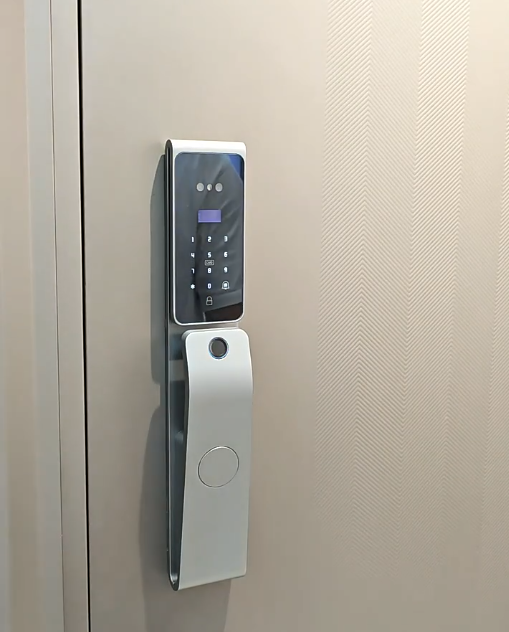
A smart door lock without handle rotation represents the stronger, more modern approach to keyless entry: instead of twisting a handle or knob to throw the bolts, the lock’s motor drives every bolt in and out automatically. You simply present a fingerprint, face, code or card, and the door unlocks and locks on its own. This guide explains what a no-handle, fully motorised design means, why it’s more secure and convenient than handle-rotation locks, and what to look for. See motor-driven models on our smart door lock range.
Once you understand the difference, it’s hard to go back to a lock where you have to wrestle a handle to lock up.

What “without handle” rotation means
Traditionally, many locks require you to turn a handle or thumb-turn to physically extend or withdraw the bolts. A smart door lock without handle rotation removes this step: the bolts are driven entirely by the lock’s motor. You still have a handle to pull the door open or closed, but you never rotate it to lock or unlock — the motor does that work when it recognises you. This fully automatic action is the hallmark of a modern, well-engineered smart lock.
How motor-driven bolts work
In a fully motorised lock, presenting a valid fingerprint, face, PIN or card signals the controller to run the motor, which extends or withdraws the bolts directly. There’s no mechanical linkage from a handle to the bolts doing the heavy lifting. Covlor locks drive every bolt in and out with an all-metal gear motor rather than a rotating handle, which lasts roughly twice as long as plastic-geared motors. This means the bolts move the same precise way every time, driven by a strong, durable motor rather than depending on how firmly a person turns a handle.
Why handle-rotation locks are weaker
Locks that rely on handle rotation to throw the bolts have a mechanical linkage that can wear, loosen or be forced over time — and they’re often found on cheaper, less robust locks. Because the bolts depend on that handle mechanism, it becomes a potential weak point. A motor-driven design avoids this entirely: the bolts are controlled by the motor and electronics, not a handle that can be leveraged or worn. It’s a fundamentally stronger arrangement.
Handle-rotation vs motor-driven: a comparison
The table below shows why a fully motorised, no-handle-rotation lock outperforms a handle-operated one on the points that matter.
| Aspect | Handle-rotation lock | Motor-driven (no handle rotation) |
|---|---|---|
| How bolts move | You turn a handle or thumb-turn | Motor drives the bolts automatically |
| Auto-lock | Not possible | Yes — door locks itself |
| Weak point | Handle linkage can wear or be forced | No external handle linkage to attack |
| Everyday use | Free a hand to turn the handle | Just present face or finger and go |
| Found on | Often cheaper, less robust locks | Modern, well-engineered locks like Covlor |
The security advantage
A smart door lock without handle rotation is more secure for several reasons. The multi-bolt body is driven firmly home by the motor every time, with no reliance on a user remembering to turn a handle. There’s no external handle linkage to attack or lever. And the design pairs naturally with auto-lock, so the door is never accidentally left unsecured. For a main door, this motor-driven security is a meaningful upgrade over handle-operated locks.
The convenience advantage
Beyond security, a no-handle-rotation lock is simply more convenient. You never have to free a hand to turn a handle — the door locks and unlocks automatically as you come and go. Arriving with bags or children, you just present your face or finger and walk in. Leaving, the door locks itself. This effortless, automatic operation is one of the quiet joys of a well-made fully motorised smart lock.
Auto-lock: only possible with motor-driven bolts
Auto-lock — where the bolts extend automatically after the door closes or after a short delay — is only possible because the bolts are motor-driven. A handle-operated lock can’t lock itself; someone has to turn the handle. With a motorised smart door lock without handle rotation, the door secures itself every time, closing the common security gap of a door left unlocked. For busy households, this is one of the most valuable everyday features.
Why the motor must be durable
Since the motor does all the work of driving the bolts, its durability is everything. A plastic-geared motor can wear or strip over thousands of cycles, which is why cheap motorised locks sometimes fail. Covlor uses an all-metal gear motor that lasts roughly twice as long, built to drive the multi-bolt body reliably for years. In a fully motorised lock, the quality of the motor is the single most important factor in longevity.
What to look for
When choosing a smart door lock without handle rotation, confirm: the bolts are driven by a durable metal-gear motor, not a handle turn; the body is multi-bolt for strong, distributed security; auto-lock is included; and there’s emergency power and a mechanical key backup. Covlor’s lineup — the CR-L108, CR-L99, CR-L88 and CR-L51 — offers face and palm recognition, fingerprint, PIN, card and app control, multi-bolt bodies driven by an all-metal gear motor, wide 40–120 mm door-thickness support and emergency USB-C power. These ensure you get the full benefit of a fully motorised design. Compare models on our smart door lock shop or in our best smart door lock guide.
Addressing common concerns
Some buyers worry about a fully motorised, no-handle-rotation lock. “What if the motor fails?” — a durable all-metal gear motor rarely fails, and if power ever runs out you have emergency USB-C power and a concealed mechanical key as independent backups. “Is it harder to use for older relatives?” — in fact it’s easier, since there’s no handle to turn; they simply present a finger or card. “What about in a power cut?” — the lock runs on its own battery, unaffected by mains power. Once you look at the concerns closely, each has a clear answer, and the motor-driven design ends up more dependable than the handle-operated locks people are used to. The key, as always, is choosing a lock with a quality motor and proper backups.
Who should choose a no-handle-rotation lock
A fully motorised, no-handle-rotation lock suits almost everyone, but it’s especially worthwhile for main doors, busy households, and anyone who values auto-lock and effortless entry. Families juggling bags and children appreciate never needing a free hand to lock up; older users appreciate the absence of a stiff handle to turn; and security-conscious buyers appreciate the firm, consistent multi-bolt action and the closing of the “forgot to lock” gap. If you want the strongest, most convenient everyday experience from a smart lock, a motor-driven design is the one to choose — provided, as always, the motor and backups are of good quality.
The bottom line
A smart door lock without handle rotation is the stronger, more convenient modern design: the motor drives every bolt automatically, so the door locks and unlocks on its own with no handle to turn. It avoids the weak, wear-prone linkage of handle-operated locks, pairs naturally with auto-lock, and delivers firm multi-bolt security every time — provided the motor is durable. Choose a fully motorised lock with an all-metal gear motor, and you get keyless entry that’s both safer and genuinely effortless.
Frequently asked questions
What is a smart door lock without handle rotation?
It’s a lock whose bolts are driven entirely by the motor rather than by turning a handle or thumb-turn. You present a fingerprint, face, code or card and the door locks and unlocks automatically. A handle may still open the door, but you never rotate it to lock or unlock.
Why is a motor-driven lock better than a handle-rotation one?
Motor-driven bolts avoid the mechanical handle linkage that can wear, loosen or be forced, and they drive the bolts firmly home every time. They also enable auto-lock. Covlor drives every bolt with a durable all-metal gear motor rather than a rotating handle, for stronger, automatic security.
Does a lock without a handle lock automatically?
Yes — a motor-driven lock can offer auto-lock, extending the bolts automatically after the door closes or a short delay, so the door is never accidentally left unlocked. This isn’t possible on a handle-operated lock, where someone must turn the handle to lock.
Is a fully motorized smart lock reliable?
It is, provided the motor is durable. Because the motor drives the bolts on every cycle, build quality is key. Covlor uses an all-metal gear motor that lasts roughly twice as long as plastic-geared ones, built to drive the multi-bolt body reliably for years.
Explore the range: see current models, features and prices on the Covlor smart door locks shop, or message us on WhatsApp +91 8860055551 for help choosing the right lock for your door.

