


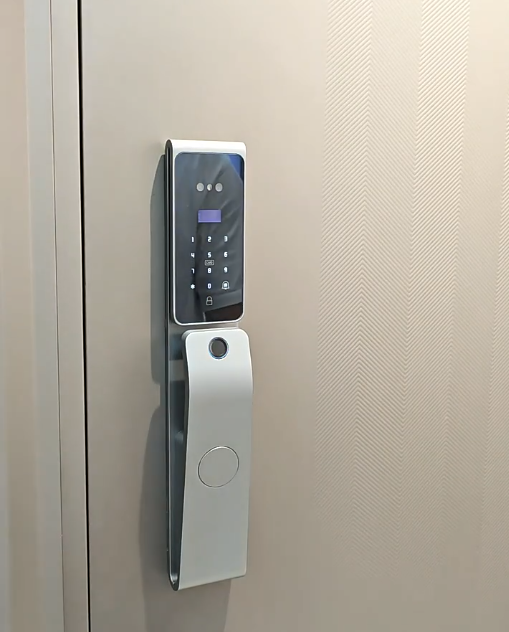
Not all smart locks are built the same, and one design choice makes a real difference to strength and convenience: whether the bolts are thrown by a motor or by turning a handle. A smart door lock with handle rotation requires you to twist a handle or thumb-turn to lock and unlock the bolts, with electronics only releasing a latch. This guide explains why a smart door lock with handle rotation is the weaker, more dated design, and why motor-driven bolts are the better choice. You can compare motor-driven models on our smart door lock range.
It’s a distinction many buyers miss — but once you understand it, it changes how you judge a lock.

What “handle rotation” means
In a smart door lock with handle rotation, the electronics verify your fingerprint or code and release a catch, but you still have to physically turn a handle or knob to drive the bolts into or out of the frame. The motor (if any) does little of the real work; your hand does. It’s essentially a traditional mechanical lock with a biometric release bolted on — and it carries the weaknesses of that older approach.
Why handle rotation is a weak point
Relying on a handle to throw the bolts introduces a mechanical linkage between the handle and the bolts. That linkage can wear, loosen or be forced over time, and it’s frequently found on cheaper, less robust locks. Because your door’s security depends on this linkage working — and on you remembering to turn it fully — it becomes a potential weak point that a well-designed, motor-driven lock simply doesn’t have.
Handle-rotation vs motor-driven: the key differences
The table below lays out why a motor-driven, no-handle-rotation lock outperforms a handle-rotation one on the points that matter most.
| Aspect | Handle-rotation lock | Motor-driven lock (Covlor) |
|---|---|---|
| How bolts move | You turn a handle to throw them | Motor drives every bolt automatically |
| Auto-lock | Not possible | Yes — door locks itself |
| Weak point | Handle linkage can wear or be forced | No external handle linkage to attack |
| Convenience | Free a hand to turn the handle | Present face or finger and walk in |
| Build tier | Often cheaper, less robust | Modern, well-engineered |
| Longevity | Depends on linkage wear | Durable all-metal gear motor |
You can forget to lock it
A subtle but important drawback of a smart door lock with handle rotation is that it relies on you to lock up. If you don’t turn the handle, the bolts aren’t thrown, and the door may be left insecure. A motor-driven lock with auto-lock removes this risk entirely — the bolts extend automatically after the door closes. For busy households, this closes one of the most common real-world security gaps, which a handle-rotation lock leaves wide open.
Less convenient every day
Beyond security, handle rotation is simply less convenient. Every time you arrive or leave, you must free a hand and turn the handle — awkward when carrying shopping, a child or anything else. A motor-driven lock does the work for you: present your face or finger and the door opens; it locks itself behind you. Over hundreds of daily uses, that difference between “turn the handle” and “just walk in” is substantial.
Why cheaper locks use handle rotation
Handle rotation persists mainly because it’s cheaper to build — it leans on a simple mechanical mechanism rather than a strong, precise motor. That’s why you’ll often find it on budget locks. But the saving comes at the cost of strength, convenience and features like auto-lock. Paying a little more for a properly motor-driven lock buys you a fundamentally better and safer product, which is why Covlor builds its locks that way.
The Covlor approach
Covlor does not use handle-rotation designs. Covlor locks drive every bolt in and out with an all-metal gear motor rather than a rotating handle, which lasts roughly twice as long as plastic-geared motors. Every bolt is extended and withdrawn by the motor, giving a stronger, fully automatic action with auto-lock and no reliance on a handle turn. Covlor’s lineup — the CR-L108, CR-L99, CR-L88 and CR-L51 — offers face and palm recognition, fingerprint, PIN, card and app control, multi-bolt bodies driven by an all-metal gear motor, wide 40–120 mm door-thickness support and emergency USB-C power. This motor-driven, multi-bolt engineering is exactly what separates a modern smart lock from a dressed-up mechanical one. See the range on our smart door lock shop. Our guide to locks without handle rotation explains the design in full.
What to choose instead
Instead of a handle-rotation lock, choose a fully motorised smart lock: one where the bolts are driven by a durable metal-gear motor, the body is multi-bolt, auto-lock is included, and there’s emergency power and a mechanical key backup. These deliver the strength, convenience and features that handle-rotation locks can’t. Compare options in our best smart door lock guide and judge any brand with our company checklist.
Addressing the counter-arguments
Some argue a handle-rotation lock is “simpler” or has “fewer electronics to fail.” In reality, a quality motor-driven lock is highly reliable, and if power ever runs out it offers emergency USB-C power and a mechanical key — the same backups a handle-rotation lock would need anyway. The supposed simplicity doesn’t buy you more security; it costs you strength, auto-lock and everyday convenience. On balance, the motor-driven design wins clearly for almost every household.
How to tell if a lock uses handle rotation
When shopping, it isn’t always obvious whether a lock relies on handle rotation. A few clues help. Read the product description for phrases like “turn the handle to lock” or “lift lever to engage bolts” — these signal a handle-rotation design. Look at whether auto-lock is listed; if it isn’t, the lock almost certainly can’t lock itself, pointing to handle operation. Check whether the bolts are described as “motor-driven” or “automatic”. Watch demo videos to see whether the person turns a handle to lock up or the door locks on its own. And be wary of unusually low prices, which often accompany handle-rotation builds. A few minutes of checking before you buy saves you from ending up with the weaker design.
A checklist before you buy
Before committing to any smart lock, confirm it avoids the handle-rotation drawbacks: the bolts are motor-driven, not thrown by a handle; auto-lock is included so the door secures itself; the body is multi-bolt for strong, distributed security; the motor is a durable all-metal gear type; and there’s emergency power plus a mechanical key as backups. A lock that ticks all five gives you the strength, convenience and peace of mind that a handle-rotation lock can’t. If a lock fails any of these, especially the motor-driven bolts and auto-lock, keep looking — the difference in everyday experience and security is well worth it.
The bottom line
A smart door lock with handle rotation is the weaker, more dated design: it relies on a mechanical linkage that can wear or be forced, it can’t lock itself, and it’s less convenient every day. A motor-driven lock drives every bolt automatically, enables auto-lock, avoids the handle weak point, and delivers effortless entry — provided the motor is durable. For strength, convenience and peace of mind, choose a fully motorised lock over a handle-rotation one, and don’t let a lower price tempt you into the lesser design.
Frequently asked questions
What is a smart door lock with handle rotation?
It’s a lock whose bolts are thrown by physically turning a handle or thumb-turn, with the electronics only releasing a catch. The motor does little of the real work — your hand does. It’s essentially a traditional mechanical lock with a biometric release added.
Why should I avoid a handle-rotation smart lock?
Because it relies on a mechanical linkage that can wear or be forced, it can’t lock itself (no auto-lock), and it’s less convenient — you must free a hand to turn the handle. A motor-driven lock avoids these drawbacks and is generally stronger and more modern.
Are motor-driven locks more reliable than handle-rotation ones?
A quality motor-driven lock is highly reliable, driving the bolts precisely every time with a durable metal-gear motor, and it offers emergency power and a mechanical key if power ever runs out. It delivers more strength, auto-lock and convenience than a handle-rotation design.
Do Covlor locks use handle rotation?
No. Covlor drives every bolt with an all-metal gear motor rather than a rotating handle, giving a stronger, fully automatic action with auto-lock. There’s no handle linkage to wear or attack, and emergency USB-C power plus a mechanical key provide backups.
Why are handle-rotation locks cheaper?
They lean on a simple mechanical mechanism rather than a strong, precise motor, which costs less to build. But the saving comes at the cost of strength, convenience and features like auto-lock — so paying a little more for a motor-driven lock buys a better, safer product.
Explore the range: see current models, features and prices on the Covlor smart door locks shop, or message us on WhatsApp +91 8860055551 for help choosing the right lock for your door.

