


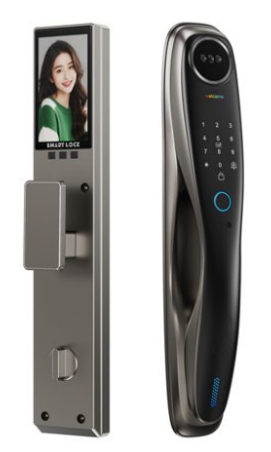
When you shop for a biometric smart lock, the choice almost always comes down to one question: fingerprint vs face recognition. Both replace your keys with your own body, both are fast, and both are far more convenient than a metal key — but they behave very differently in daily use. This detailed comparison breaks down speed, accuracy, security, night performance, and cost, so you can pick the right one for your home or business. (New to smart locks? Start with our complete guide to smart door locks.)
The Short Answer
If you want the quickest, most budget‑friendly biometric entry, a fingerprint door lock is the safe choice. If you want completely hands‑free, contactless unlocking — ideal when you arrive with bags, kids, or groceries — a face recognition lock wins. The good news: most premium Covlor® locks include both, plus PIN and card, so you rarely have to choose just one.
How Fingerprint Door Locks Work
A fingerprint lock captures the unique ridges of your finger with a capacitive or optical sensor and matches them against enrolled profiles stored securely on the device. Recognition happens in a fraction of a second, and a good sensor works even with slightly damp or dry fingers. Because everything is processed on the lock, fingerprint unlocking needs no internet and no phone.
How Face Recognition Locks Work
A face recognition lock uses a camera — ideally with 3D or infrared depth sensing — to map the geometry of your face and confirm your identity. AI‑based facial recognition means the door opens as you approach, hands‑free, in under a second. Depth sensing also makes it resistant to photo or video spoofing.
Fingerprint vs Face Recognition: Side by Side
| Factor | Fingerprint Lock | Face Recognition Lock |
|---|---|---|
| Unlock speed | Instant (touch) | Under 1 sec (approach) |
| Hands‑free | No (need a finger) | Yes |
| Works in the dark | Yes | Yes (with IR) |
| Hygiene | Touch required | Contactless |
| Best for kids/elderly | Sometimes tricky | Very easy |
| Typical cost | Lower | Higher |
Speed and Everyday Convenience
Fingerprint unlocking is genuinely instant — but you still have to reach out and place a finger accurately on the sensor. Face recognition removes even that step: the lock recognises you as you walk up, which is a noticeable upgrade when your hands are full. For busy households, that hands‑free experience is often the deciding factor.
Accuracy and Reliability
Fingerprint sensors are extremely reliable for most adults, but can struggle with very young children, worn fingertips, or wet hands. Face recognition is more forgiving across age groups and works consistently once enrolled. The most dependable setup is a lock that offers both, so if one method has an off day, the other simply takes over.
Security and Anti‑Spoofing
Security depends on quality, not just the method. A cheap 2D face camera can be fooled by a photo; a proper 3D/AI face lock cannot. Likewise, a basic optical fingerprint reader is weaker than a capacitive one. Whichever you choose, insist on biometric anti‑spoofing, encrypted storage, auto‑lock, and tamper alarms.
Which Should You Choose?
Choose fingerprint if you want the most affordable, proven biometric lock and everyone in the home has easy‑to‑read prints. Choose face recognition if you value contactless, hands‑free entry, or if children and elderly family members find fingerprints fiddly. Choose both — the smartest option — with a multi‑method lock that also keeps PIN and card as backups.
Cost and Long‑Term Value
Fingerprint locks generally cost less than face‑recognition models, because a fingerprint sensor is cheaper than a 3D camera module. But the price gap has narrowed, and combination locks that include both methods often deliver the best value — you pay once and never feel limited. When comparing prices, factor in build quality, warranty, and installation support, not just the unlock method.
Installation and Enrolment
Both lock types fit standard Indian main doors and typically replace your existing mortise handle set. Enrolment differs slightly: for fingerprints, each user registers a finger or two by touching the sensor a few times; for face recognition, users look at the camera briefly to capture their facial map. Enrolling multiple fingers or angles improves reliability. A professional installer from a brand like Covlor® handles fitting and initial setup for you.
Real‑World Scenarios: Which Wins?
Arriving with groceries in both hands: face recognition wins — no free finger needed. Letting in a plumber for an hour: a temporary PIN beats both biometrics. A toddler who wants to open the door: face recognition is easiest. Wet hands after washing up: face or PIN sidesteps a damp‑finger misread. This is exactly why multi‑method locks feel effortless — the right option is always available for the moment you are in.
Privacy Considerations with Face Recognition
Some buyers worry about privacy with a camera on the door. Reputable face‑recognition locks process and store facial data locally on the device — not in the cloud — and encrypt it, so your face map never leaves your lock. If privacy is a top concern, confirm on‑device processing, or lean toward fingerprint, which stores only a mathematical template rather than an actual image of your finger.
Accessibility for Every Family Member
A lock is only useful if everyone can open it. Face recognition tends to be the most accessible for children, older adults, and anyone with limited dexterity, while fingerprints suit the majority of adults perfectly. Enrol every household member during setup, add a shared PIN as a universal fallback, and issue cards for occasional visitors — so nobody is ever stuck outside your own front door.
Maintenance and Durability
Fingerprint sensors need an occasional wipe to stay accurate, while face cameras should be kept clean and unobstructed. Both are rated for years of daily use in quality locks. Keep the firmware updated on connected models, replace batteries when the low‑battery alert appears, and both methods will keep performing reliably season after season.
Why Covlor® Locks Give You Both
Covlor® Smart AI Door Locks combine fingerprint, AI face recognition, palm, PIN, card, and app unlocking in a single device — so your family gets the best of every method with warranty and installation support across India. Explore the range in the Covlor® smart lock shop or see the flagship CR L51‑S.
Frequently Asked Questions
Which is more secure, fingerprint or face recognition?
Both are highly secure when built well. Face recognition with 3D/AI depth sensing resists photo spoofing, while capacitive fingerprint sensors resist fake prints. For maximum security, choose a lock that offers both plus a PIN backup.
Does face recognition work in the dark?
Yes. Good AI face‑recognition locks use infrared sensors, so they unlock reliably in low light or complete darkness — often more consistently than in harsh backlight.
Are fingerprint locks reliable for the elderly or children?
Fingerprints can be harder to read for very young children or people with worn fingertips. In those cases, face recognition or a PIN is more dependable — which is why multi‑method locks are ideal for families.
Can someone unlock a face recognition lock with a photo?
No, not on a quality lock. Modern AI face locks use 3D depth mapping and anti‑spoofing, so a printed photo or phone screen will not fool them.
Should I buy a fingerprint or face recognition smart lock?
If you want the fastest, most affordable option, choose fingerprint. If you want hands‑free, contactless entry, choose face recognition. Best of all, most Covlor® locks include both, so you never have to compromise.
Get the Best of Both Worlds
Why settle for one biometric method? Choose a Covlor® lock with fingerprint and face recognition. Browse Covlor® Smart AI Door Locks →
