


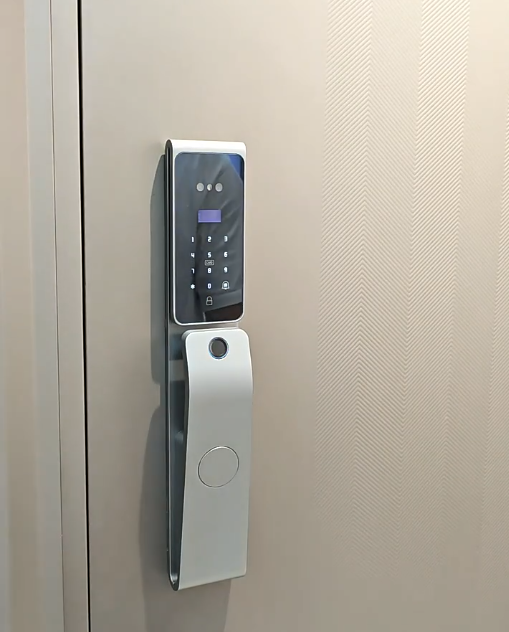
Should you stick with a traditional key-and-cylinder lock, or upgrade to a smart one? The smart door lock vs traditional lock question is one every homeowner eventually faces. Both keep your door shut; the differences lie in how you open it, how secure it really is, and how it fits modern life. This full comparison weighs them across security, convenience, access, cost and reliability so you can decide with confidence.
By the end you’ll know exactly which type suits your home — and why millions are making the switch.

What each one is
A traditional lock uses a physical key to operate a cylinder and bolt — the familiar lock-and-key you’ve used all your life. A smart door lock replaces the key with electronic and biometric methods — fingerprint, face, PIN, card or app — and usually adds connectivity for remote control and alerts. It keeps a mechanical key as an emergency backup, so it’s an upgrade rather than a complete departure. If you want the detail on smart versus simpler electronic locks, see our smart vs digital door lock guide.
| Aspect | Traditional lock | Smart lock |
|---|---|---|
| Entry | Metal key | Fingerprint, face, PIN, card, app |
| Lost keys | Costly re-keying | Revoke a code in seconds |
| Guest access | Hand over a key | Issue a temporary code |
| Visibility | None | Access log and alerts |
| Auto-lock | No | Yes, motor-driven bolts |
Convenience: the biggest difference
This is where smart locks win decisively. No keys to carry, lose, copy or hide; you enter with a touch or a glance. You can grant temporary access to guests and deliveries without handing over anything physical, and on connected models unlock from anywhere. A traditional lock does none of this — every entry needs the right physical key, every guest needs a copy, and losing a key often means changing the lock. For daily life, the convenience gap is large.
Security: is smart safer?
Traditional locks can be picked, bumped or opened with a copied key, and a key hidden under a mat is a known weakness. A quality smart door lock removes the copyable key entirely, adds anti-spoofing biometrics, locks out repeated wrong attempts, and — with a multi-bolt body — resists forcing as well as or better than a traditional lock. It also tells you who entered and when. Provided you choose a well-built smart lock, it’s generally as secure or more secure than a traditional one, with the bonus of awareness.
Access control and visibility
A traditional lock offers no record of entries and no way to limit access by person or time. A smart lock gives each household member their own credential, lets you issue and revoke temporary codes, and keeps a timestamped log of every entry. For families, landlords and anyone managing help or deliveries, this control and visibility are simply impossible with keys. Our access-technologies guide covers the methods in detail.
Reliability and power
Here traditional locks have a simple advantage: no batteries. A smart lock runs on power, so it needs batteries — but good ones last months, warn you early, and include emergency USB-C power plus a mechanical key, so being “locked out” is a solved problem. Mechanically, a smart lock’s durability depends on its motor; a quality all-metal gear motor, as Covlor uses, lasts far longer than plastic gears. With a well-made lock, reliability is excellent on both counts.
Cost comparison
A traditional lock is cheaper up front. A smart lock costs more initially but saves the recurring costs and hassles of cutting keys, re-keying after a lost key, and the security risk of copied keys. Over its life, a smart lock’s convenience and control often justify the difference — especially on a main door you use every day. For the full price picture, see our smart door lock price in India guide.
When a traditional lock still makes sense
Traditional locks aren’t obsolete. For a rarely-used storeroom, an outbuilding, or a very tight budget, a simple key lock may be perfectly adequate. Some people also prefer the absolute simplicity of no electronics. The honest answer is that the right choice depends on the door and your needs — but for a main entrance in a modern home, the smart lock’s advantages are hard to ignore.
When to choose a smart lock
Choose a smart door lock if you want keyless convenience, control over who enters and when, visibility of comings and goings, and stronger, more modern security on your main door. For most households, that describes exactly what they want. Covlor’s lineup — the CR-L108, CR-L99, CR-L88 and CR-L51 — offers face and palm recognition, fingerprint, PIN, card and app control, multi-bolt bodies, wide 40–120 mm door-thickness support, an all-metal gear motor and emergency USB-C power, giving you the full set of advantages at fair value. Compare specific models in our best smart door lock in India guide.
A quick side-by-side verdict
Traditional lock: cheapest, simplest, no batteries — but no convenience, no access control, no visibility, and a copyable key. Smart lock: keyless convenience, per-person access, logs and alerts, no copyable key, and modern security — at a higher but worthwhile cost, with batteries managed by early warnings and backups. For a main door in a modern home, the smart lock is the clear upgrade; for a low-use, low-risk door, a traditional lock can still do the job.
Switching from a traditional lock: what to expect
Making the switch is easier than most people expect. A smart lock typically replaces your existing lock using the same door preparation, so there’s rarely major work involved, and you keep a mechanical key for emergencies — so nothing about the change leaves you without a familiar fallback. The adjustment period is short: within a day or two, reaching for a fingerprint or face feels more natural than digging for keys. Most people who switch report the same thing — that they quickly stop thinking about keys altogether, and wonder why they waited. If you rent, you can usually refit the original lock when you leave, making the upgrade low-risk even for a rented home.
The bottom line
In the smart door lock vs traditional lock comparison, the traditional lock wins on simplicity and up-front cost, while the smart lock wins decisively on convenience, access control, visibility and modern security. For the door that matters most — your main entrance — a well-built smart lock is the upgrade most households are glad they made. Match the lock to the door, and you’ll make the right call.
Frequently asked questions
Is a smart door lock safer than a traditional lock?
Generally yes, when well-built. A quality smart lock removes the copyable key, adds anti-spoofing biometrics and wrong-attempt lockout, resists forcing with a multi-bolt body, and tells you who entered — advantages a traditional lock can’t match.
What happens to a smart lock if the power goes out?
It runs on its own batteries, which last months and warn you early, and includes emergency USB-C power plus a mechanical key — so a power cut never locks you out, unlike the common fear suggests.
Is a smart door lock worth the extra cost over a traditional lock?
For a main door used daily, usually yes. The convenience, per-person access, logs and modern security outweigh the higher up-front cost, and you avoid the recurring costs of cutting keys and re-keying after a loss.
Explore the range: see current models, features and prices on the Covlor smart door locks shop, or email us at hello@covlor.de for help choosing the right lock for your door.
